
As another Lame Cherry exclusive in matter anti matter.
I used to have some friends in Ohio, but most things online they were bored creatures who wanted entertainment and when I stopped the show, they moved on to better things, leaving me to rot.
The one mentioned corn spiders in the corn in Ohio and webs on her as a kid. I had no idea what she was talking about as all we had were barn spiders which kind of look like things from horror movies.
In a drought though we had scads of grasshoppers and these menacing looking spiders appeared. I had to ask, but this was the first time I had seen corn spiders in the Brier.
Since then I have become quite protective of them. I protect daddy and granddaddy long legs, black racers if they stay outside, barn spiders in the barn and of course corn spiders.
I have watched them without figuring out what they are and finally still not having the time in November before forecast bad weather and my aching body, I looked up corn spiders, and post the explanation of their life cycle below.
A male’s life is spent roaming around until he finds a female. When he does, he typically constructs a web nearby and begins to court her by plucking the strings of her web, which she can detect. (Males usually have a drop line ready when they approach females—occasionally, a hungry female will eat her mate!)
After mating, the female lays her eggs on a sheet of silk and covers them with a layer of silk topped by another layer of paper-like silk. Then, she bundles them into a roundish ball, which she places in her web, off to the side or sometimes near the center. She’ll produce up to three, rarely four, egg sacs during the summer. Up to one inch (25 mm) in diameter, each sac may hold from 300 to more than a thousand eggs, and she carefully watches them.
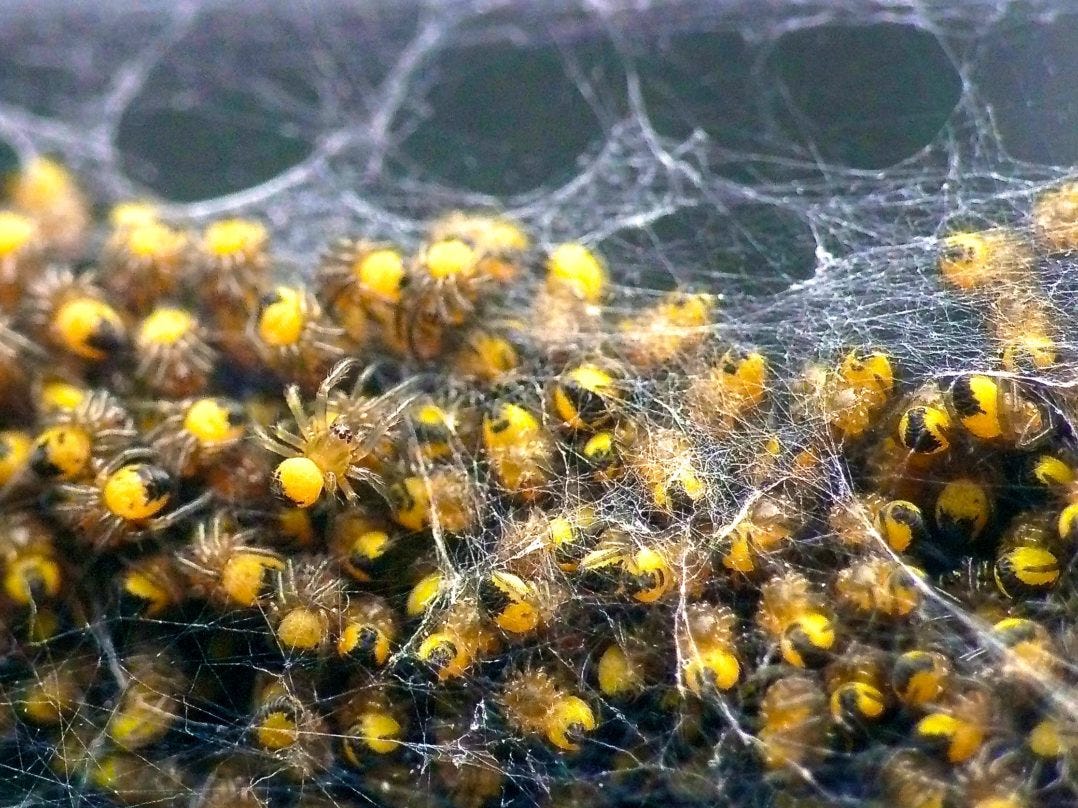
The spiderlings hatch in late summer or fall and look like tiny adults, except they lack mature reproductive organs. They stay within their egg sac, in a state of dormancy, through the winter. Then come spring, the spiderlings, who look just like their parents, emerge and grow ever larger through the summer, shedding (molting) their exoskeleton several times to make way for their growing bodies. By late summer and fall, they’re a year old, fully grown, and sexually mature. That’s when we begin to notice the females. They’ll mate, lay eggs, and the cycle starts again.
I have a number of egg sacks on the house, on an old car and I did by the Holy Ghost figure out that those papersack looking things were, but I never could figure out how they worked. As you can see the spiders hatch out in the spring. In normal years during Indian Summer we always had plumes of little spiders floating around in the fall. That would not be corn spiders, because they are a spring hatch. I have never seen them in mass, and am tempted to bring in a sack and jar it up and see what happens, but if I forgot it would bother me in imprisoning the babies, but I liked this picture below as it reminds me of the Granddaddy longlegs we hatch in the house here.
Lifespan
In temperate climates, the lifespan of female Black-and-yellow Garden Spiders begins in the fall and lasts until the first hard frost of the following year. Males die within their first year, after mating. In warmer climates, females may live for several years.
These are August spiders here, when I noticed them in their webs. I tend to swat grasshoppers and feed them to the spiders. As I do not mow lawn, and we have weeds galore, the spiders have a nice stable platform like corn stalks for their webs.
They are mean looking buggers and I hope never to be bitten by them as their fangs are rattlesnake looking, but this is the kind of robot which should be built as they are a God tough design and durable. They are built for grasshoppers I think which are another durable God design in nature.
Anyway that is the story. The Chinamen will leave rice bundle straw on their fields for the black racers to winter in. I just leave my weeds around. Spiders have their place in the kinds that I cultivate and protect. I will kill those damned recluse and widow’s if we ever have any, but the rest of them I pretty much leave alone, as long as they are not in the house like those big spiders that look like giant black racers. I keep wolf spiders around when they pop through the doors and let them crawl around hunting as they do not end up in bed. Usually have one in the mailbox as the postal people leave them alone. I painted it this year so it had to find new digs for awhile, but am sure it will be back.
Nuff Said
agtG
CLICK HERE to support the popular girl


